
Samuel F.B. Morse
Inventor of the Telegraph and Morse Code
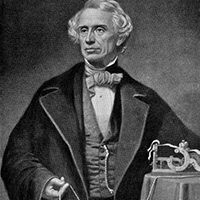
Like a lot of other American inventors, Samuel F.B. Morse was fairly eclectic in his interests. He was a well-known portrait painter and the first president of the National Academy of Design. He also ran for office several times, patented three new pumps and studied electricity. Ultimately, his interests would lead him to his most famous accomplishment: inventing the electric telegraph.
Inspired by a conversation he overheard about electromagnetism on a ship ride from Europe, inventor Samuel Morse conceived the idea for an electric telegraph (though, unbeknownst to him, the idea was not exactly new). The concept of his invention was that pulses of electricity could be used to communicate information over wires.
Though not part of the original design, the invention came to include a dot-and-dash code that used different numbers to represent the letters of the alphabet. In time, this newly invented code would become known as "Morse Code."
With the aid of some partners, Samuel F.B. Morse applied for a patent for his new invention and went to work building a prototype. Not long after, Morse was transmitting ten words per minute with the device at a New York exhibition.
In May 1844, Morse sent a message ("What Hath God Wrought!") from Washington to Baltimore using the first inter-city electromagnetic telegraph line in the world. Soon after, the telegraph invention would become commonplace across the United States and, eventually, throughout the world.
Frequently Asked Questions About Samuel F.B. Morse
Who was Samuel F.B. Morse?
Samuel F.B. Morse was an American inventor, painter, and early developer of telegraph technology. He helped change long-distance communication by creating a practical system that could send messages over wires.
What did Samuel F.B. Morse invent?
He is best known for developing a workable telegraph system and co-creating what became known as Morse code — a system of dots and dashes used to represent letters and numbers in telegraph messages.
What is Morse code?
Morse code is a symbolic system in which combinations of short and long signals (dots and dashes) stand for letters and numbers. It was used to send messages over telegraph lines and later in radio communication.
How did Morse’s telegraph work?
His telegraph used electrical impulses sent along a wire. At the receiving end, a device translated those impulses into marks or sounds that could be decoded back into the original message using Morse code.
Why was his work important?
Before the telegraph, long-distance communication relied on physical travel. Morse’s system made it possible to send messages quickly across great distances, which revolutionized journalism, business, and personal communication.
When did he invent the telegraph system?
He developed his early telegraph designs in the 1830s and 1840s, and the first successful long-distance telegraph line — from Washington, D.C. to Baltimore — was put into operation in 1844 with a famous message.
What was the first message sent by Morse’s telegraph?
The first message sent over the line from Washington to Baltimore was “What hath God wrought.” It showed that electrical communication was possible over a long distance in a reliable way.
Was Morse just an inventor?
No. Before working on telegraphy, Morse was a trained painter and successful artist. His interest in communication technology grew from practical problems and intellectual curiosity.
How did his invention change society?
The telegraph made it possible to share news, conduct business, and coordinate activities across great distances in hours or minutes instead of days or weeks. It reshaped the way people stayed in touch and how information spread.
Did Morse face challenges in developing his telegraph?
Yes. He had to refine his ideas through experimentation and secure funding and support to build infrastructure. His success came from persistence and collaboration with others who believed in his vision.
Where can I learn more about Samuel Morse’s work?
You can learn more through biographies, history books on communication technology, museums with exhibits on early telegraphy, and educational resources that explore the evolution of electrical communication.
For more information on inventor Samuel F.B. Morse's telegraph and Morse Code inventions, please visit:
White River Valley Museum: Morse Code History
Locust Grove: The Samuel F.B. Morse Historic Site
Inventor Samuel Morse: Telegraphy & Morse Code